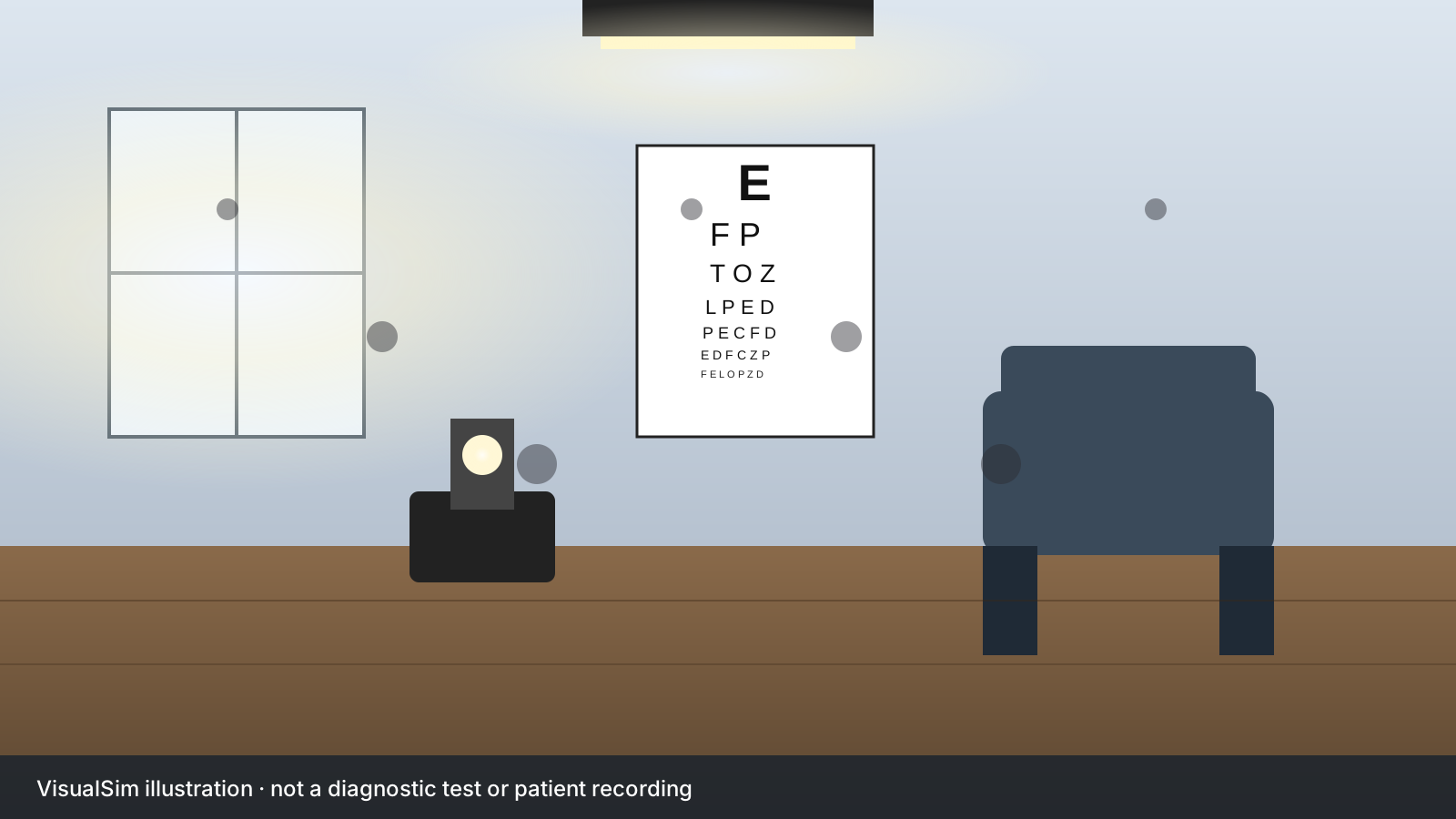
A shadow noticed in the visual scene
Floaters are small dark shapes that can drift across vision. They may be easier to notice against a bright background and can move away when you try to look directly at them. Many come from changes in the vitreous that cast shadows on the retina. [1]
A new shower of floaters, flashes or a curtain-like shadow can accompany a retinal tear or detachment. A symptom that looks like the examples here still needs appropriate assessment when it is new or changing. [2]
Shape varies
Dots, strands, cobwebs and rings are descriptive examples.
Movement matters
Explain drifting and when the shapes are most noticeable.
Change matters more
A sudden increase needs assessment, even if the shapes look familiar.
Terms in this guide
- Weiss ring
- A ring-like vitreous opacity associated with separation near the optic nerve.
- Dilated examination
- An examination using drops to widen the pupil.
One condition. Different experiences.
Illustrative shapes can help you communicate. They cannot identify the cause or replace an examination of the retina.
Original VisualSim schematic illustrations, informed by the cited clinical descriptions. These are not study figures, patient recordings or validated severity levels. Clinical basis: source 1. Artwork: © VisualSim; see image provenance.
The vitreous, the retina and a visible shadow
The vitreous is a transparent gel. Changes in its structure can create shadows that are perceived as floaters. Other causes include bleeding or inflammation, so the appearance of one shape does not identify the underlying condition. [1]
The simulator uses a separate overlay of representative shapes. It cannot reproduce the exact optics, position or adaptation of an individual floater. The same drawing may look different depending on screen brightness and background.
What can look similar?
PVD
A vitreous separation may cause new floaters and flashes. Not every floater means a new PVD. [2]
Visual static
Continuous pan-field grain is a different description from a few mobile shadows. Symptoms can coexist.
Retinal symptoms
A fixed missing area, curtain or reduction in sight is especially important to describe. [2]
Similar-looking symptoms can have different causes. A matching picture cannot establish a diagnosis.
What an assessment may involve
Tell the eye clinician about onset, a sudden increase, flashes, trauma, recent eye surgery and any missing vision. A dilated retinal examination may be needed to look for a cause and complications. [1]
- Say what is newSeparate longstanding shapes from a recent change.
- Describe additional symptomsInclude flashes, pain, blur or a shadow.
- Ask about follow-upKnow what a reassuring examination does and does not exclude.
What may help—and what is still being studied
Many floaters do not require a procedure. If symptoms remain very disruptive after the cause has been assessed, an eye specialist can discuss options and their risks. Surgery and laser procedures are not interchangeable, and neither is appropriate for every floater. [1]
A sham-controlled laser trial enrolled 52 eyes with symptomatic Weiss rings. It reported benefit in that selected group, but was too small to establish uncommon complications. The result should not be generalized to every shape or recent-onset symptom. [3]
A 2026 review included 15 laser studies covering 718 treated eyes, but only two studies were randomized. Reported improvements in selected patients do not establish that uncommon harms are absent, or that laser is better than surgery. Discuss symptoms, retinal findings, alternatives and risks rather than choosing from a simulated floater shape. [5]
What this can mean for daily life
Explain the practical impact
Try Reading, Faces or Clinic, then describe which tasks are difficult. The illustration is not a disability scale.
Use comfortable scenes
You do not need to stare at a bright sky or look toward the sun to demonstrate floaters. A comfortable screen scene is enough.
Bring a clearer description to your appointment
Choose the questions you want to discuss. These choices stay in this page’s memory.
Research, with the context left in
Evidence about treating selected persistent floaters should be kept separate from urgent assessment of new symptoms.
What the evidence supports
Persistent floaters can impair function even when letter-chart acuity is good. Treatment evidence must discuss both symptom benefit and harm. Vitrectomy has substantial observational evidence of satisfaction but meaningful risks. Laser trials and a 2026 systematic review suggest benefit in selected patients; heterogeneous, mostly nonrandomized evidence cannot prove rare harms are absent or establish that laser is superior to surgery.
How we select and interpret researchShah and Heier: YAG laser vitreolysis versus sham for symptomatic Weiss-ring floaters
Participants allocated to laser reported greater improvement in floater symptoms than participants receiving sham treatment over six months.
Limits and applicability: Small, single-center trial with selective eligibility and limited follow-up. It cannot rule out uncommon complications or be generalized to every floater type, young vitreous or new symptoms.
How to read this evidence: Randomization and a sham comparison strengthen evidence of symptom benefit for the selected Weiss-ring population; safety and wider applicability remain uncertain.
Dysager et al.: Efficacy and safety of pars plana vitrectomy for primary symptomatic floaters
Most included series reported high satisfaction or symptom relief. Pooled complications included cataract, retinal tears, retinal detachment, glaucoma and infection. These risks belong in the same discussion as the reported benefit.
Limits and applicability: Selection and reporting bias, heterogeneous surgery and baseline lens status. Pooled percentages are not a personalized consent estimate; cataract risk especially depends on whether the natural lens is present.
How to read this evidence: A useful synthesis of real surgical outcomes, with lower causal certainty because evidence was predominantly nonrandomized and techniques and follow-up differed.
Alnajres et al.: Nd:YAG laser vitreolysis for primary symptomatic floaters — systematic review and meta-analysis
Patient-reported visual function and contrast sensitivity improved in pooled analyses; best-corrected visual acuity did not materially change. Selected patients may experience useful symptom relief.
Limits and applicability: The absence of permanent vision loss in the included studies does not establish zero risk. Before-and-after observational findings cannot resolve treatment selection effects or a direct laser-versus-vitrectomy comparison.
How to read this evidence: More comprehensive than a single laser trial, but the authors identify limited certainty from methodological heterogeneity and predominantly nonrandomized designs.
Hahn et al., ASRS ReST Committee: Reported complications following laser vitreolysis
Reports included raised intraocular pressure or glaucoma, cataract or capsule injury, retinal tears/detachment, hemorrhage, scotomas and increased floaters.
Limits and applicability: No denominator of all treated people, voluntary reporting and no control group. The report cannot determine a complication rate or prove that the procedure caused each event.
How to read this evidence: Important for identifying possible serious harms that small efficacy trials may miss; unsuitable for estimating their frequency.
Kokavec et al.: Nd:YAG laser vitreolysis versus pars plana vitrectomy for vitreous floaters
The review found no eligible randomized trials directly comparing laser with vitrectomy at its search date.
Limits and applicability: Historical search date. Do not label it a current complete review or use it to dismiss later sham-controlled laser trials. The 2026 review also calls for stronger direct comparisons.
How to read this evidence: A rigorous description of an evidence gap, rather than evidence that either option is ineffective.
Questions researchers still need to answer
- Which floater characteristics and functional difficulties were represented in a proposed treatment study?
- What is the absolute benefit and harm profile for my lens status, retinal risk factors and surgeon’s approach?
- Do the study outcomes capture reading, contrast and everyday disability rather than acuity alone?
- Are there adequately powered, long-term randomized comparisons of laser, surgery and observation?
These are editorial interpretations, not formal GRADE ratings or independent clinical review. A large sample, recent date or well-known publisher does not make every claim certain.
Trusted places to go next
Selected clinical references, research and support organizations. Each link explains who it is for.
NEI: floaters
Plain-language symptoms, causes and urgent warning signs.
Laser trial
Read the selection criteria and limitations behind a treatment study.
Organizations & ways to connect
Selected charities, professional organizations and communities, with their scope and region. Official pages checked 24 October 2026. Community discussions are peer support; each external service has its own privacy and moderation rules.
National Eye Institute: floaters and retinal emergencies
Plain-language explanation of drifting shadows, dilated examination and emergency warning signs. The institute does not provide individual diagnosis or a physician-referral service.
Foundation of the American Society of Retina Specialists
Retina-specialist patient fact sheets, large-print and translated materials, a patient podcast and a specialist directory. Clinical education; not a peer-support group.
RNIB
Accessible condition information, practical and emotional support, assistive technology and routes to community connection. Broader sight-loss support rather than a condition-specific medical service.
Connections listed by the organization.
Prevent Blindness
Patient education about floaters and retinal emergencies, care-access information and Living Well with Low Vision resources. Its social channels provide public education rather than individual diagnosis.
Connections listed by the organization.
Questions you may still have
Do all floaters need treatment?
No. Assessment and the effect on daily life guide the discussion. [1]
Can the shape tell me whether there is a tear?
No. A matching ring, thread or dot cannot establish retinal safety.
Is a white screen a clinical test?
No. It may make floaters easier to notice, but it cannot diagnose their cause or exclude complications.
Sources, image credits and review status
Compiled by VisualSim from clinical references and published research. Sources checked 24 October 2026. Independent clinical review has not been recorded; no named clinical reviewer or clinical validation is claimed. Research evidence and its limitations are linked below.
- National Eye Institute. Floaters. Clinical information; sources checked 24 October 2026.
- American Society of Retina Specialists. Posterior vitreous detachment. Clinical information; sources checked 24 October 2026.
- Shah and Heier. YAG laser vitreolysis vs sham for symptomatic vitreous floaters (2017). Clinical information; sources checked 24 October 2026.
- Nixon et al. Prospective study of PVD and retinal tears (2024 issue). Clinical information; sources checked 24 October 2026.
- Alnajres et al. Nd:YAG laser vitreolysis for primary symptomatic floaters: systematic review and meta-analysis (2026). Clinical information; sources checked 24 October 2026.
- Dysager et al.: Efficacy and safety of pars plana vitrectomy for primary symptomatic floaters (2022). Systematic review and meta-analyses of 18 studies, 2,077 eyes in 1,789 patients
- Hahn et al., ASRS ReST Committee: Reported complications following laser vitreolysis (2017). Retrospective review of voluntarily reported safety events in 15 patients
- Kokavec et al.: Nd:YAG laser vitreolysis versus pars plana vitrectomy for vitreous floaters (2017). Cochrane systematic review of randomized head-to-head comparisons
The simulator helps people communicate an experience. It cannot diagnose a condition, measure a visual field, or establish that someone is safe to drive.